
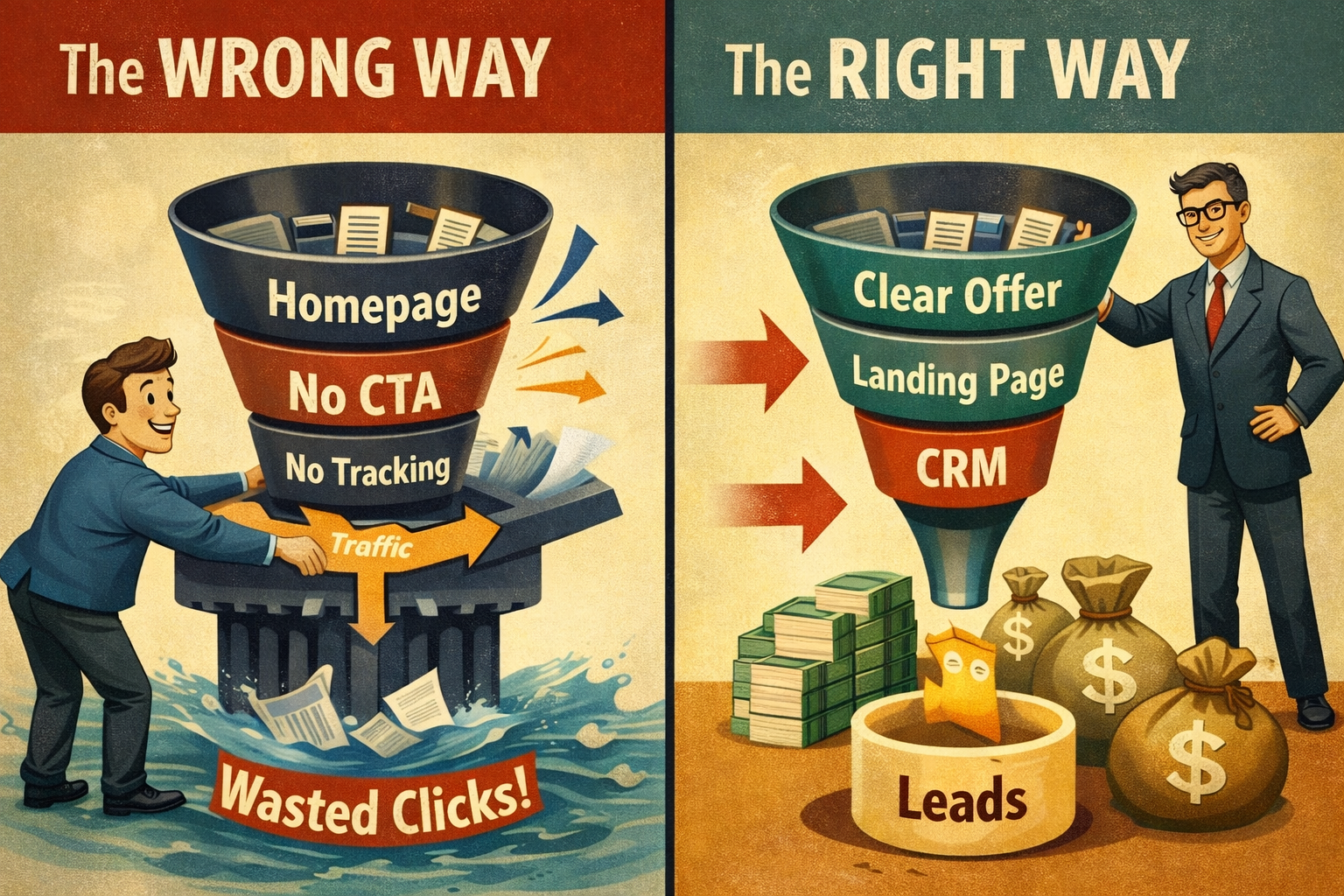
Most Google Ads campaigns fail for small businesses because ads amplify existing problems instead of fixing them. When the offer, landing page, tracking, or follow-up system is weak, paid traffic only makes the gaps more visible and more expensive.
Google Ads is not a growth shortcut. It is a performance amplifier.
Many small businesses assume ads fail because of targeting, keywords, or budget. In reality, campaigns fail because the underlying system is not designed to convert attention into leads or sales.
Why do most Google Ads campaigns fail for small businesses?
Google Ads campaigns fail most often due to a combination of structural and strategic issues, not because the platform itself does not work.
The most common reasons include:
- Traffic is sent to the wrong page
Many businesses send paid traffic to their homepage instead of a conversion-focused landing page. Homepages are designed to inform, not convert, which leads to wasted clicks and low lead volume. - There is no clear offer or next step
Ads perform best when the user knows exactly what to do next. Vague messaging, multiple calls to action, or unclear value propositions create hesitation and reduce conversion rates. - Tracking is incomplete or incorrect
Without proper conversion tracking, businesses cannot see what is working. This leads to decisions based on assumptions instead of data, causing budgets to be misallocated. - Follow-up systems are weak or nonexistent
Many campaigns technically generate leads, but those leads are never contacted quickly or consistently. Slow or inconsistent follow-up dramatically lowers return on ad spend. - Budgets are set without realistic expectations
Small budgets can work, but only when expectations match reality. Expecting immediate profitability without testing, optimization, and iteration almost always leads to disappointment.
Ads do not fix broken systems
Paid advertising does not create demand or clarity. It reveals whether demand and clarity already exist.
When a business runs Google Ads without a strong foundation, the platform exposes every weakness in the funnel. That is why some businesses say ads “do not work,” while others scale profitably using the same tools.
The difference is not the platform.
The difference is the system behind it.
What small businesses misunderstand about Google Ads
One of the biggest misconceptions is that Google Ads is primarily about keywords or bidding strategies. While those matter, they are secondary to conversion mechanics.
Google Ads rewards relevance, clarity, and user experience. If the ad message, landing page, and follow-up process are aligned, even modest budgets can generate consistent leads.
Without that alignment, even large budgets struggle to produce results.
How to approach Google Ads the right way
Before running ads, small businesses should focus on building a system that can handle traffic profitably.
That includes:
- A clear offer with one primary action
- A landing page built to convert, not just look good
- Accurate conversion tracking
- A defined follow-up process
- Realistic performance benchmarks
When those pieces are in place, Google Ads becomes a predictable growth lever instead of a risky expense.