
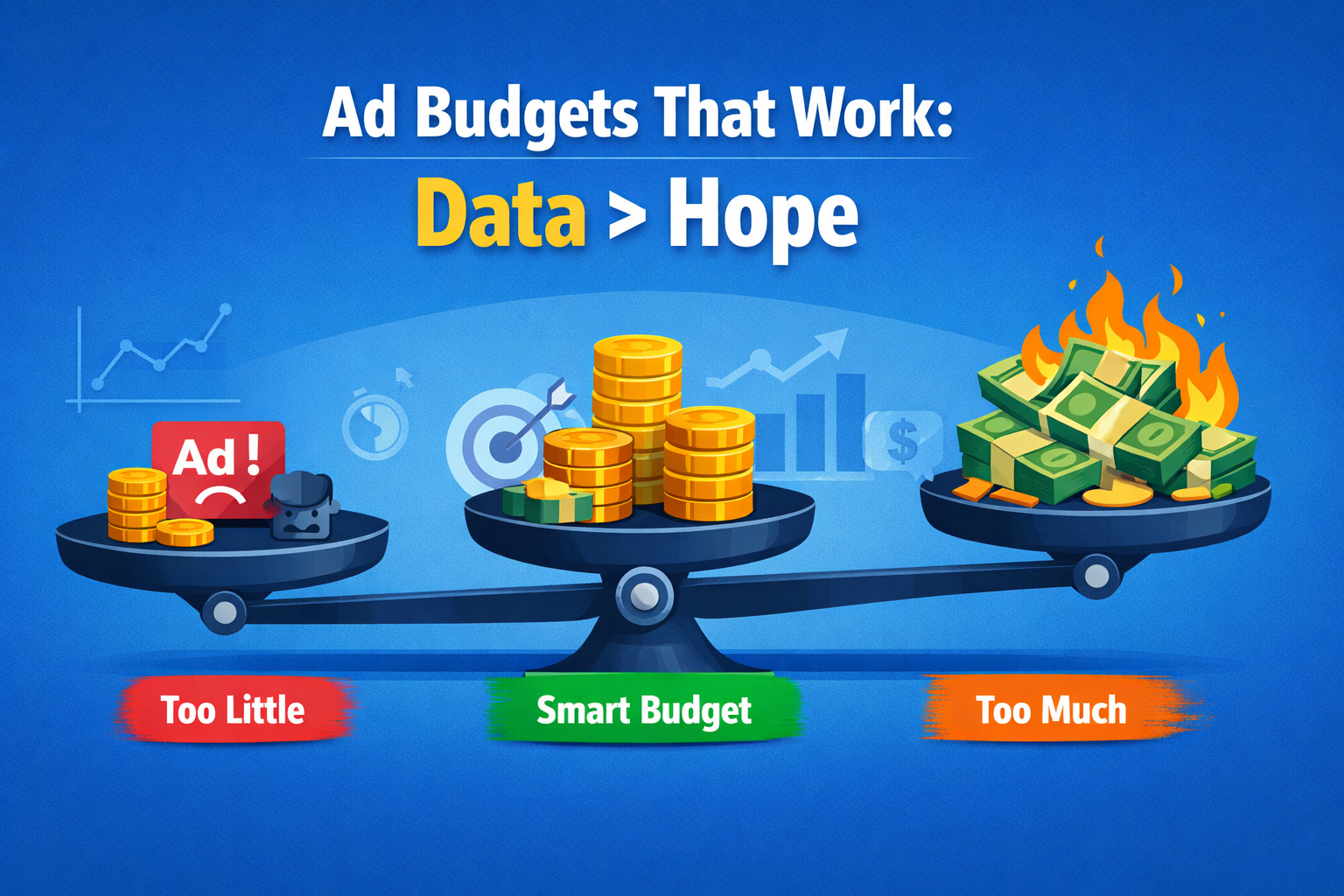
A service business should spend enough on ads to generate consistent data, not just occasional leads. In most cases, this means budgeting for learning and optimization before expecting predictable results.
Ad budgets fail when they are set based on hope instead of math.
Many service businesses underinvest early, then conclude ads do not work. Others overspend without a system and burn cash. The right budget sits between those two extremes.
How much should a service business realistically spend on ads?
The right ad budget depends on lead value, conversion rates, and sales capacity. However, there are realistic minimums that apply to most service businesses regardless of industry.
A practical ad budget must account for:
- The cost to generate meaningful data
Ads need enough volume to show patterns. Small budgets often do not generate enough clicks or leads to determine what is working. Without data, optimization stalls. - The average cost per lead in your market
Some industries naturally have higher costs due to competition and buyer intent. Budgets must align with those realities instead of fighting them. - The time required to test and refine
Profitable campaigns are rarely perfect at launch. Budget must allow room for testing ads, landing pages, and audiences before scaling. - Your ability to follow up and close leads
Spending more does not help if leads are not contacted quickly or consistently. Budget should match operational capacity. - Short-term learning versus long-term growth
Early ad spend should be viewed as an investment in clarity and systems, not immediate profit.
Why very small budgets struggle
Very small budgets often fail because they cannot support learning. When spend is too low, campaigns either do not generate enough traffic or stop before patterns emerge.
This leads to false conclusions like “ads do not work,” when the real issue is insufficient testing time and volume.
Ads need room to breathe.
A realistic starting range for service businesses
For many service businesses, a realistic starting range is one that supports consistent traffic and lead flow over at least 30 to 60 days. This allows enough time to evaluate performance without rushing decisions.
The exact number matters less than the mindset. The budget must support learning first, then optimization, then scale.
Profitability follows clarity.
How to think about ad spend the right way
Instead of asking, “How little can I spend?” service businesses should ask, “What budget gives me enough signal to make good decisions?”
Ads reward consistency and alignment. When budget, funnel, and follow-up work together, ad spend becomes predictable instead of stressful.
The goal is not to spend more.
The goal is to spend intelligently.