
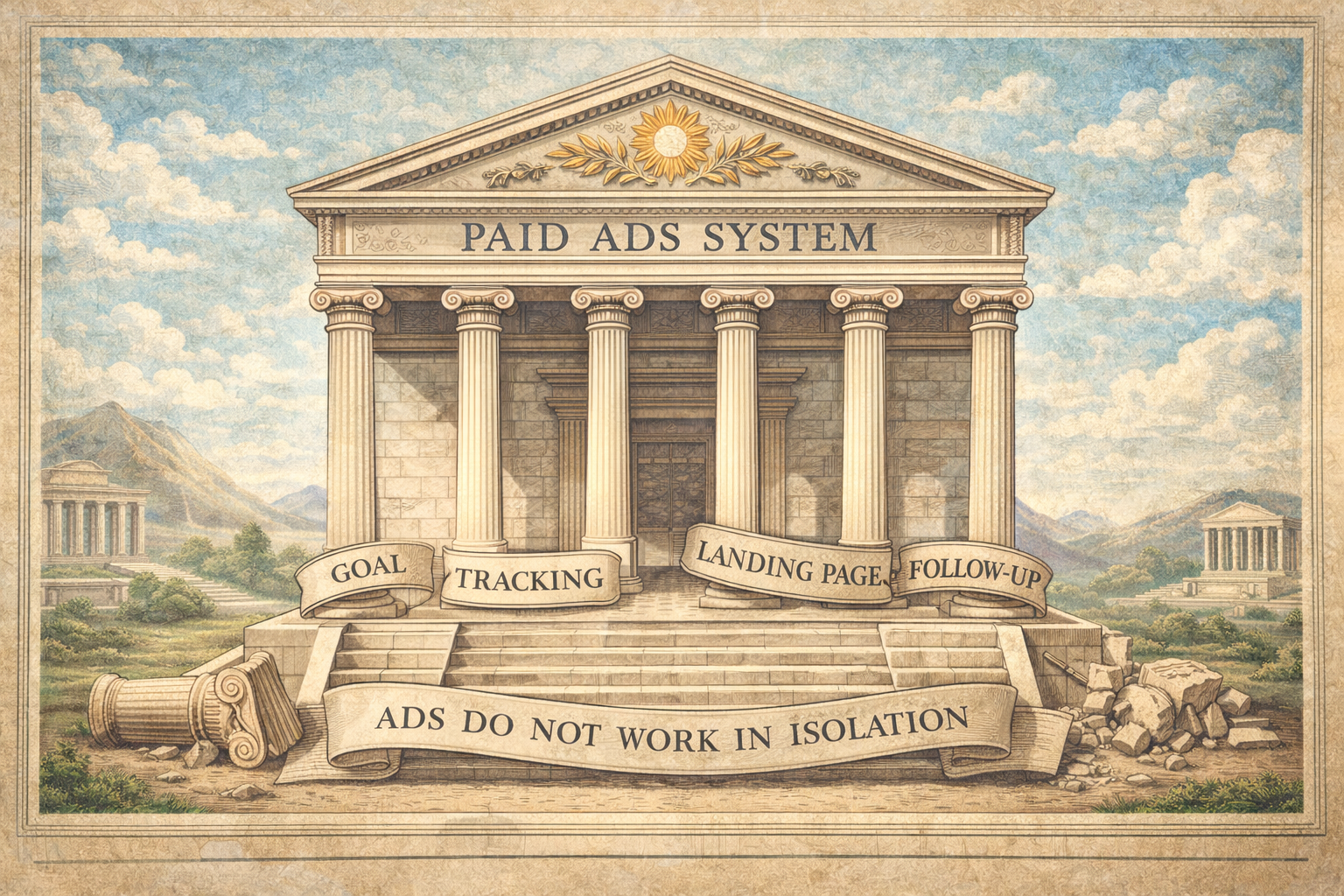
A good paid ads setup includes more than just ads. It combines clear goals, proper tracking, a focused landing page, and a defined follow-up process so results can be measured and improved over time.
Ads do not work in isolation.
They work as part of a system.
Many businesses think a setup means launching campaigns and choosing targeting. In reality, setup is about creating the conditions where ads can succeed before spending increases.
What does a good paid ads setup actually include?
A strong paid ads setup creates clarity for both the platform and the business running the ads. When these pieces are missing, performance becomes inconsistent and hard to diagnose.
A complete paid ads setup typically includes:
- A clearly defined conversion goal
Every campaign should be built around one primary outcome, such as a lead form submission or booked call. Without a clear goal, optimization becomes guesswork. - Accurate conversion tracking
Tracking must be properly installed and tested so real actions are recorded. This allows platforms to optimize correctly and gives businesses confidence in their data. - A conversion-focused landing page
Traffic should be sent to a page designed for one action. The page should match the ad message and remove unnecessary distractions. - Aligned ad messaging
Ads should speak directly to the problem being solved and clearly communicate the next step. Vague or generic messaging lowers relevance. - A defined follow-up process
Leads must be contacted quickly and consistently. A setup is incomplete if there is no plan for what happens after a conversion.
Why setup matters more than ongoing optimization
Many performance issues trace back to poor setup. When the foundation is weak, ongoing changes produce inconsistent results.
A strong setup reduces wasted spend, shortens learning time, and makes optimization decisions clearer.
Fixing setup issues often improves performance faster than adjusting ads.
Common mistakes in paid ads setups
Some of the most common setup problems include:
- Tracking only clicks instead of conversions
- Sending traffic to unfocused pages
- Launching multiple goals at once
- Running ads without follow-up readiness
These mistakes create noise instead of insight.
How to approach setup the right way
A good paid ads setup should be treated as infrastructure, not a one-time task. It creates the environment where ads can be tested, measured, and improved predictably.
When setup is done correctly, ads feel manageable.
When setup is rushed, ads feel risky.
The difference is preparation.